Monday, November 28, 2011

Cyber Monday outlook: big deals, record sales


Did you skip the lines on Black Friday? There's still Cyber Monday -- and analysts are expecting an abundance of deals to bring in record online sales this year.
Andrew Lipsman, an industry analyst at data tracking firm ComScore, said sales for the one-day shopping event are projected to hit a record $1.2 billion this year.
Almost every major retailer plans on taking advantage of the hottest day to shop online. According to the Shop.org's eHoliday survey, eight out of 10 online retailers will offer promotions on Cyber Monday.
A survey by comparison shopping site PriceGrabber found that 39% of consumers who planned to shop over the four-day Thanksgiving weekend said they intended to do so on Cyber Monday. That's up 2 percentage points from last year.
 Does Cyber Monday really save you money? Cyber Monday can get you to Hawaii Shoppers deal hunting on Cyber Monday FBI cracking down on Cyber Monday scams
It's a trend analysts are calling "couch commerce" -- more people want to spend money online from the comfort of their homes rather than head out to the shops.
Lelah Manz, chief strategist of commerce at Akamai, cited the rise of tablet computers in the last year as a major game-changer in e-commerce.
"If you think about when the concept of Cyber Monday was first born, it was a time when people had dial-up access at home -- it was the office place or the workplace where they could access sites," Manz said. "Now everyone has broadband access. People have tablets, they're able to get online earlier and at home, and retailers are trying to capture that mind share."
According to an IBM Coremetrics report, 15% of web traffic in the U.S. in November will stem from smart phones and tablets rather than PC's. In order to tap into that traffic, retailers are rolling out the deals early this year, said Manz.
As valuable ad space is snatched up by major retailers, mid-sized retailers are leaking deals ahead of Cyber Monday to get their place in the spotlight too, said Graham Jones, general manager of PriceGrabber.
"What we saw last year -- a lot of the medium size retailers, they didn't get in front of the consumers, so they are the ones leaking the deals earlier," Jones said. "The earlier these deals are coming out is a function of the retailers not wanting to be squeezed out of the limelight."
But don't expect the online deals ahead of Cyber Monday to impact the big day. According to a Shop.org survey, nearly 60% of workers will go online to shop for holiday gifts at work, and many of the retailers are waiting for Monday to push out some of the best promotions.
"Consumers have come to expect the absolute best online holiday deals on Cyber Monday," Pam Goodfellow, BIGresearch Consumer Insights Director, said in a release. BIGresearch is a marketing research firm that conducts surveys for the industry trade group National Retail Federation.
Online companies are still placing big bets on Cyber Monday and taking steps to prep for a day when online traffic is expected to spike. OpenSky, an online shopping platform that offers products curated by various celebrities and influential people -- from chef Tom Colicchio to fashion designer Cynthia Rowley -- has been ramping up efforts to make sure the site runs smoothly.
"We're expecting our biggest day ever - we have 10,000 new people joining OpenSky every day and we expect sales to be five times our largest day," said OpenSky Founder John Caplan. "We've made improvements to the site to make it run faster. We've added additional shipping options, gift wrapping, customer service staff and have all hands on deck from now through the holiday."
The company also plans to announce lifestyle guru Martha Stewart as a curator on the site - a move the six-month-old company hopes will boost interest in the biggest online shopping day of the year.


By Laurie Segall, CNN Money

UN report: Syrian forces commit 'gross violations' of human rights


Syrian security forces have committed "gross violations of human rights" since anti-government protests began in March, a United Nations report released Monday said.
The U.N. independent international commission on Syria's assessment was based on interviews with 223 victims and witnesses, but observers were not allowed access to the country, the report said.
According to the report, evidence "documents patterns of summary execution, arbitrary arrest, enforced disappearance, torture, including sexual violence, as well as violations of children's rights."
Military deserters told the commission that they had been ordered to shoot at unarmed protesters without warning, the report said.
 Arab League sanctions punish Syria Economic sanctions for Syria
"The commission reiterates its call for immediate and unhindered access to the Syrian Arab Republic," the report said.
Earlier this month, the United Nations High Commission for Human Rights estimated that government forces had killed at least 3,500 civilians.
Syria's government has consistently blamed armed gangs for the violence and said security forces are protecting the people.
"The Arabic Syrian military, which we are all proud of, has given martyrs in order to protect the life of civilians," Syrian Foreign Minister Walid Moallem said Monday.

By the CNN Wire Staff

Thursday, November 24, 2011

Report: Suspected CIA 'spies' captured in Iran


An Iranian lawmaker said Thursday that officials in Iran and Lebanon have arrested 12 CIA "spies" who intended to a "deal a strong blow" to Iran, state media reported.
Parliamentarian Parviz Sorouri said the alleged spies were trying to cripple Iran in nuclear, military and security areas, said Iran's official IRNA news agency.
The report did not say when the suspects were arrested or add details about the arrests.
Earlier this week, a U.S. official confirmed to CNN that informants that worked with the CIA had been captured in Lebanon. The official would not say how many informants were arrested.
 Iran: We don't need nuclear weapons Covert action in Iran?
One of the means used by Hezbollah counterterrorism operatives to identify the informants was to trace their cell phone calls, the official said.
The official added, "look who helps them," a reference to Iran, with which Hezbollah shares tactics and information.
The United States considers Hezbollah, which has close ties to Iran and Syria, to be a terrorist organization.


By the CNN Wire Staff
CNN's Mitra Mobasherat contributed to this report

3 American students freed in Egypt


Three American college students arrested on suspicion of throwing Molotov cocktails during a protest in Cairo were released Thursday, a spokesman for the Egypt general prosecutor's office told CNN.
Joy Sweeney, whose son Derrik Sweeney is one of the three students, told CNN's "American Morning" she was overjoyed by the news.
"We are just so blessed and so grateful right now," she said. "I can't wait to give him a big hug."
The students were to be taken to a physician for a medical examination and back to the police station for paperwork to be processed, then to their dorm rooms, she said. They may be able to call home afterward.
The Egyptian attorney general is not going to appeal against the trio's release, she said.
 Egypt's military rulers apologize Parties considering Egypt election delay A short-lived truce in Cairo
The family is keen for Derrik to return home as soon as possible, for his own safety, she added.
Roberto Powers, the U.S. consul general in Egypt, advised that as the three students' pictures had been plastered all over the media, "it wouldn't be safe or prudent for them to remain in the country," she said.
She said her son told her in a telephone call Wednesday that "they had done nothing wrong."
Sweeney, Gregory Porter and Luke Gates are students from different schools attending American University in Cairo on a semester-long, study-abroad program, according to the school.
Sweeney, 19, is a Georgetown University student from Jefferson City, Missouri; Porter, 19, from Glenside, Pennsylvania, attends Drexel University in Philadelphia; and Gates, 21, of Bloomington, Indiana, goes to Indiana University.
Their arrests came amid violent protests against Egypt's ruling military council in Cairo's Tahrir Square that had claimed dozens of lives by late Wednesday.
Drew Harper, a friend of the three students, told CNN some parts of the media had given an inaccurate impression of them as being irresponsible.
Harper, 22, a film student from New York who has been in Cairo for three months, described Sweeney, Porter and Gates as intelligent, well-informed and nonviolent.
"I don't believe for one second that those Molotov cocktails belonged to the boys," he said.
"These are not drunk college students looking for a thrill or boys hellbent on committing suicide in a blaze of glory."
He accused the Egyptian military of wanting to "pin the recent violence on foreigners" and said they had wrongly accused the three Americans.
Georgetown University President John J. DeGioia welcomed the news that Georgetown student Sweeney and his fellow Americans had been freed.
"Our entire Georgetown community is deeply grateful to all those whose prompt attention and work led to their release," DeGioia said in a statement.
A relative calm fell over Tahrir Square on Thursday as Egypt's military leaders apologized for the 38 deaths nationwide and vowed to prosecute offenders and pay the medical bills of those injured.
Some 3,250 people have been wounded, according to Hisham Sheeha of Egypt's Health Ministry.
Adil Saeed, spokesman from the prosecutor's office, said late Wednesday that a bag filled with empty bottles, a bottle of gasoline, a towel and a camera had been found with the three American students.
"They denied the bag belonged to them and said it belonged to two of their friends," Saeed said.
The latest clashes between protesters and police broke out Saturday near Tahrir Square, the epicenter of the movement that led to Hosni Mubarak's ouster as president in February.
Demonstrators are calling for the country's interim military rulers to step down immediately.
Soldiers erected barbed wire barricades to separate protesters and police early Thursday.


By the CNN Wire Staff
CNN's Mohamed Fahmy and journalist Ian Lee in Cairo, and Devon Sayers in Atlanta contributed to this report.

Wednesday, November 23, 2011

Report: 1 in 5 U.S. children at risk of hunger


Saprina Gressman helps her daughter Kiara, 4, chop tomatoes in a cooking class in New York.


Students gathered as the chef sliced tomatoes with a plastic knife in a Brooklyn public school cafeteria. Their eyes followed as she held up a slender green cylinder before the crowd of parents and kids in plastic aprons and hairnets.
"What's that?" kids shouted.
"It's a scallion. But don't eat it now," warned Leigh Armstrong, a culinary student and volunteer chef. "It doesn't taste like celery."
Armstrong was helping at Cooking Matters, a free, six-week class that teaches parents and kids how to shop for and prepare healthy, inexpensive meals. The program launched 20 years ago through the nonprofit Share our Strength, and it now serves more than 11,000 families across the country.
Most participants use or have used food stamps, free or reduced-price school lunches or food pantries to cover their nutritional needs, and almost all are still looking for ways to stretch a few ingredients into meals.
The number of families that struggle to get enough food has increased in recent years.
The U.S. Department of Agriculture reported that in 2010, 14.5% of households in the United States -- about 17.2 million -- lacked the resources to provide enough food for everybody. Among those, about 6.4 million households saw normal eating patterns disrupted or reduced because there wasn't enough food.
Food insecurity -- uncertainty about where the next meal will come from -- is particularly hard on one group: children.
It's a time of record need, a time when you're seeing people from all walks of life needing to turn to assistance to meet their food needs.
Paula Thornton-Greear, Feeding America spokeswoman
The nonprofit Feeding America, a network of more than 200 food banks around the United States, reports one in five children are at risk of hunger. For children in African-American or Latino households, it's closer to one in three.
They're likely to have trouble focusing in school. They might experience illness or poor health as a result. They're also likely to struggle with stress at home or in class. While many are eligible for free or reduced-price food at school, those programs don't provide food at night, on weekends or during breaks from school.
Hunger is still a more frequent problem for homes headed by single parents and for homes below the federal poverty line, the USDA reports, but it has also crept into homes that have never experienced it before.
"It's invasive and real," said Paula Thornton-Greear, a Feeding America spokeswoman. "It's a time of record need, a time when you're seeing people from all walks of life needing to turn to assistance to meet their food needs."
For adults, the most important step might be talking about it, Thornton-Greear said -- reaching out to friends and family who can help and learning what government and nonprofit food programs are available.
"At some point, we're all in need of something," she said. "It's reflective of a society experiencing a huge downturn. It's not reflective on one individual."
For kids, it might mean getting adults more engaged in teaching nutrition and stopping hunger before it starts.
On TV, a new "Sesame Street" puppet, Lily, is talking about food insecurity from the perspective of a 7-year-old who doesn't always have enough to eat.
 CNN Hero: Bruno Serato
In Orange County, California, chef and restaurateur Bruno Serato feeds pasta to about 300 children every night.
Serato, one of the Top 10 CNN Heroes of 2011, began cooking for kids when his mother visited from Italy and saw a child eating potato chips for dinner. The boy, like dozens of others near his restaurant in Anaheim, lived in a motel, where his family had limited access to food and cooking space.
"'Bruno, you must feed them pasta,'" he recalled her saying. Serato continued the nightly pasta feast throughout the recession, even as his restaurant struggled.
"They're customers," he told CNN earlier this year. "My favorite customers."
And back in Brooklyn, it means teaching parents to shop and cook with kids in tow. The Cooking Matters curriculum includes taking families to grocery stores and then getting them into kitchens at schools, community centers or even housing units.
Today's menu: breakfast burritos with eggs, cheese and homemade salsa. The cost: less than $2 a serving.
At Saprina Gressman's first Cooking Matters class this month, the 25-year-old mother of three said her kids first told her about the class.
"I'm hoping to learn a lot," she said, as she helped her 4-year-old daughter, Kiara, cut a tomato to make salsa. "I'm hoping to learn to cook with my children, because you need patience."
While parents will usually be the ones to budget, buy and cook food, getting kids excited about preparing and eating homemade meals can keep everyone engaged in healthier choices and smart shopping.
Aliyah Rowe, the Cooking Matters program coordinator for City Harvest in New York, said some members of the class rely on food stamps, but it's designed for anyone with food insecurity -- people who recently lost jobs and have to rethink their food budgets, or families that occasionally seek assistance from food banks.
It also gets parents and kids spending time together and talking about the food the fuels them.
"I remember baking with my grandmother, but that doesn't happen anymore," Rowe said. "The reality is parents are busy; you have some that work two jobs. But the kids come here and they are so excited, and they go home excited. And that inspires parents to cook with their children."


By Alyse Shorland and Jamie Gumbrecht, CNN

Jailed Afghan rape victim has sentence reduced, remains in jail


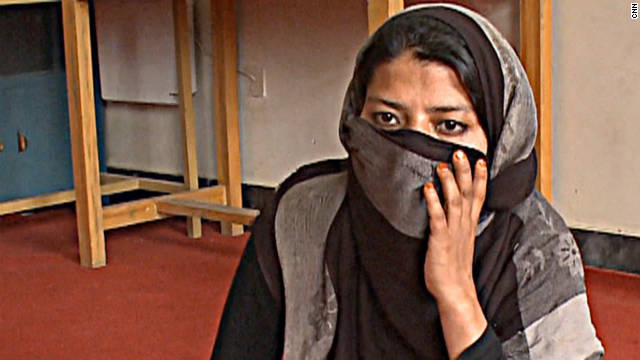
Afghan prosecutors announced Wednesday that a young rape victim, jailed for adultery after reporting the crime and pushed into marrying her attacker, would have her sentence reduced from twelve to three years. The prosecutor said she would, for now, remain in jail -- with her child -- for not reporting her attack fast enough.
In a remarkable case that is all too common in Afghanistan but has drawn international attention, 21-year-old Gulnaz was attacked by a relative two years ago, but sentenced to 12 years in jail for adultery.
She has since given birth to a girl from the attack. Because of the dishonor of sex outside of wedlock, she had been given the choice of marrying her attacker to get out of jail and legitimize her infant daughter in the eyes of Afghanistan's conservative society.
The child is imprisoned with her at Badambagh Prison on the outskirts of Kabul.
 Jawad: Afghan system failed rape victim Woman being forced to marry her rapist
Gulnaz says she at first tried to hide the attack against her because she could be killed for bringing shame on her community. Only her pregnancy exposed the attack and began criminal investigations that led to her conviction for adultery.
On Wednesday a spokesman for the Afghan attorney general said her sentence had been reduced by another court hearing to three years and that the main remaining charge against her was not reporting her attack early enough. A lawyer for Gulnaz, Kim Motley, said her client was only on Tuesday made aware of the reduced sentence and there had been no official notification of it.
The attorney general spokesman, Rahmatullah Nazari, said their investigation had concluded there was no rape, but instead sex outside of wedlock, resulting in both the male attacker and Gulnaz being convicted of adultery.
"Gulnaz claims that she has been raped. But because she reported the crime four months later, we couldn't find any evidence [of an attack]," Nazari said. "She was convicted for not reporting a crime on time."
Gulnaz's attacker denied having sex with her. He told CNN he was serving jail time because he had been accused of rape. His conviction records show he is in jail for "zina", a Dari word that directly translates as "adultery." Human rights workers note that rape cases are often handled as adultery in Afghanistan's court system.
The spokesman for the prosecutor added, however, that Gulnaz might soon receive a presidential pardon.
"There is a strong possibility that she would be pardoned under a presidential decree in the upcoming important dates like Prophet's birthday or Afghan new year," said Nazari.
Nazari said the Afghan prosecutor's investigation had concluded that Gulnaz and her attacker had had consensual sex several times. Months later, when it emerged she was pregnant he said, their families met to try and settle the issue through a financial payment. When those discussions broke down, Nazari said, the accusation of rape was made.
The courts ultimately found both parties guilty of adultery, Gulnaz receiving two years, and her attacker seven. A later court ruling then increased her sentence to twelve years. A third court hearing, which happened in the past month but about which Gulnaz heard little until Tuesday, decided that she should serve a total of three years -- not for adultery but instead for failing to report a crime quickly enough.
Throughout her interview with CNN, Gulnaz was emotional but consistent and clear in telling her story of a single incident of rape by one attacker, the husband of her cousin, when her mother left her alone to make a hospital visit.


By Nick Paton Walsh, CNN

Tuesday, November 22, 2011

Transitional Cabinet named in Libya


Libya's acting prime minister on Tuesday announced a new Cabinet approved by the National Transitional Council as the North African nation continues to reshape itself following the end of Moammar Gadhafi's 42-year rule.
Abdurrahim el-Keib read out the names of the 25 officials who will join him on the Transitional Executive Board, completing another step in the formation of a government intended to lead the country to democratic elections next year.
The list included Col. Osama Juwaili as defense minister. He is the head of the Zintan brigade that on Saturday captured Saif al-Islam Gadhafi, son of the deposed and slain strongman.
At the news conference to announce the names, al-Keib said the new Cabinet represents all of Libya, with posts given to qualified candidates from across the country.
A main concern among Libyans is building a strong army to bring stability in the aftermath of the Gadhafi regime. Currently, regional militias hold sway, with some conflicts erupting between rival groups.
The hope is that the new government can include many of the militia fighters into a unified military, while also disarming others and creating jobs for them.
Also Tuesday, International Criminal Court prosecutor Luis Moreno-Ocampo arrived in Libya following the weekend capture of Saif al-Islam Gadhafi and the announced arrest of former Libyan intelligence chief Abdullah al-Senussi.
Both men are accused of crimes against humanity, and Moreno-Ocampo said Libya is obliged to cooperate with the international court under U.N. Security Council Resolution 1970 to bring them to justice.
"This is not a military or political issue; it is a legal requirement," he said.
Libyan authorities have said they want to try Saif al-Islam Gadhafi, once his father's heir apparent, in Libya. The International Criminal Court must first determine that Libya is capable of conducting such a trial, officials have said.
Despite the announcement of al-Senussi's arrest, no photos or other confirmation has been provided by the National Transitional Council. The International Criminal Court has yet to confirm al-Senussi's arrest.

From Raja Razek and Jomana Karadsheh
CNN.COM

What is Obama's post-super committee strategy?


One of the oldest axioms in politics is that you should never let a good crisis go to waste. Now that the hopelessly divided deficit reduction super committee has failed, it is apparent to just about everyone that Washington has a serious crisis of governance.
Question: What -- if anything -- will President Barack Obama do about it? With the 2012 election season already under way, should he assume a deal is impossible and use the panel's failure as a campaign weapon? Or is he better off knocking heads together on Capitol Hill and trying to ram through a deal that will prevent unpopular automatic spending cuts from taking effect starting in 2013?
Veteran political observers are divided, and the answer could have serious ramifications for the economy and policies Americans will live with for the foreseeable future. The president promised Monday to veto any attempt to undo the $1.2 trillion in automatic cuts -- including $600 billion from the Pentagon -- slated under current law.
"There will be no easy off ramps on this one," he declared. "We need to keep the pressure up to compromise."
Don Baer, communications director in Bill Clinton's White House, says Obama has a lot to gain by making a serious push for a new deal, maybe starting with the high-profile State of the Union address in late January or early February.
"From a political standpoint, the president will be better served by showing that he's ready to be a leader regardless of what actually happens," Baer told CNN. "(Obama should) push for Congress to engage ... and show that perhaps he alone is the true grown-up leader of the country."
Doing so puts Obama in "a better position than being at the same level as Republicans, pointing fingers about who is to blame," Baer said. "What the country is looking for is for someone to deliver solutions and perform the role they were elected to do."
He added, "It's amazing how often the right thing to do is also the right thing politically. Right now the perception is everyone's playing politics (and) that's a not a healthy situation."
And what about the Democrats' liberal base? If Obama somehow did manage to cut a deal that includes new major spending reductions, wouldn't that risk deflating the president's core supporters at a time when conservative Republicans are already itching to get to the polls?
Nonsense, according to Baer. Fear of the Republicans will help drive liberal turnout in November.
"Where are they going? Are they going to vote for Romney? Are they not going to turn out in droves? Presumably, they're still going to rally around Obama," he said.
Norman Ornstein, a resident scholar at the conservative American Enterprise Institute, said the response that GOP members of Congress get from their constituents over the Thanksgiving holiday could help determine the probability of reaching an agreement.
"We know how it plays out immediately, which is that members go home for Thanksgiving, and they're going to get an earful," Ornstein said.
"The question is which earful will matter the most. Is it going to be those members who hear from their constituents, 'What's wrong with you morons? Get together and cut a deal?' Or is it going to be from those who give the earful, 'If you raise one dime in taxes, we're going to kill you in a primary'?"
Constituents' reactions "could harden positions, especially among tea party Republicans, or could provide a little more urgency to act," he said.
But Thomas Mann, a senior political analyst at the Brookings Institution, sees little possibility that congressional Republicans will yield on taxes any time soon. Trying to cut a deal with them is not only futile, it risks dragging the president down politically by more closely associating him with a seemingly dysfunctional Congress, he said.
"If I were Obama, I would invest little if anything in trying to do something before the election to avoid" the automatic cuts, Mann said. "He should push aggressively to extend the payroll tax cut and unemployment benefits, and keep all the of Bush tax cuts on track to expire at the end of 2012."
Any deal with congressional Republicans, Mann argued, would almost certainly include a permanent extension of the 2001 and 2003 Bush tax cuts.
"This would greatly worsen the deficit problem and remove the only political lever Obama would have, if re-elected, to force revenue raising," he said, noting the tax cuts' estimated $4 trillion value over the next decade.
Adam Sheingate, a Johns Hopkins University political scientist, agreed that Republicans are locked into their anti-tax position, a fact that makes any pre-election deal unlikely. Sheingate insisted that the Democratic-controlled Senate will ensure Obama won't be put in the position of having to veto any unacceptable proposal.
The only real question now is how the president plays it politically, he said.
"Presidents adopt a leadership stance above the partisan fray when the opposition is likely to take more of the blame for inaction or obstruction. Both Truman in 1948 and Clinton in 1996 showed the electoral benefits of such a strategy," Sheingate said.
"Given that the likelihood of failure by the super committee was so high, Obama took a calculated risk by remaining somewhat removed from the process," he said. "Whether that strategy pays off depends on his ability to pin the failure on the Republicans and to portray the GOP as out of touch with voters."
Sheingate said that "it is now up to Obama to craft his campaign in a manner that draws out the sharp distinctions between his vision for the future and that of his Republican rivals."
But Northeastern University political scientist Bill Mayer said that, from his perspective, congressional Republicans were the ones who showed a bit more flexibility in the super committee talks. Mayer pointed to a proposal from super committee member Sen. Pat Toomey, R-Pennsylvania, to raise taxes by $250 billion by limiting individual deductions.
Democrats -- including Obama -- would "rather have an issue than a bill, which is not all that uncommon," Mayer said. Lately, he noted, Obama has been gaining traction in some opinion polls through a combination of economic populism and blasting the GOP for inaction.
The president "may make a few attempts (at a deal) so that he can claim he tried to reach a compromise, but any attempt will be designed so that Republicans will reject them," Mayer said.
Mayer also noted that since none of the automatic spending cuts are scheduled to take effect before 2013, there will still be a brief window to get things done after the election. Key decisions will almost certainly be postponed until November or December 2012, he said.
Democratic strategist Steve Murphy, who ran Dick Gephardt's 2004 presidential campaign, said it's possible for Obama to pursue a deal seriously while also using the super committee's failure to boost his standing in the polls.
"Of course, he's going to use it as a campaign issue," Murphy said, referring to Republican opposition to higher taxes on the wealthy. "Republicans may still think it's 2010, but we're a long way from there."

By Alan Silverleib, CNN

Monday, November 21, 2011

Chaos, deja vu in Tahrir Square


Chaos reigned Monday in Cairo's Tahrir Square as demonstrators battled security forces, marking three days of bloody violence in Egypt's capital.
In the same spot where demonstrators launched protests 10 months ago that ousted longtime President Hosni Mubarak, there is now a sense of deja vu as protesters stand up against the military in charge.
Twenty-two protesters have died and 1,700 have been wounded, a spokesman for the ministry of health said.
Among police, 102 officers and conscripts have been injured, with wounds ranging from gunshots to burns from Molotov cocktails, an interior ministry spokesman said. One officer has a critical bullet wound to his head.
 Protesters attacked in Tahrir Square Protesters flee Egyptian security forces Arab spring burdens Egyptian economy Egypt Islamist fears
"People here feel that they have been cheated and that they have moved from an autocracy to a military dictatorship," protester Mosa'ab Elshamy said. "So they are back to the square -- back to square one -- to ask for their rights once again."
The military said it is "extremely sorry" for the events under way, and stressed that it will be handing over power when a new government is in place. Egypt's parliamentary elections are set to take place November 28.
But demonstrators are upset about a proposed constitutional principle that would shield the military's budget from scrutiny by civilian powers. They worry that the military would be shaped as a state within a state.
Some protesters shout that they believe Mubarak is running the military council and the entire country from prison.
Doctors at Cairo's Tahrir Square said injuries in the latest fighting include gunshot wounds, excessive tear gas inhalations and beatings to the head.
"I have received many people suffering of convulsions," said Tarek Salama, a medic in a makeshift hospital in Tahrir Square. "Lots of gunshot wounds from rubber and bird shots. And I have seen two cases who have been hit with actual live bullets."
On Monday, CNN saw police use tear gas and rubber bullets in attempts to disperse the protesters, who responded with Molotov cocktails. Both sides threw rocks as well.
CNN saw captured protesters beaten and shocked with Taser-like devices.
CNN also saw bullet holes and a pool of blood. Witnesses said one young man was shot from a nearby building. Witnesses showed CNN mobile phone footage of the wounded young man before an ambulance picked him up.
But the police efforts did not show any success in dispersing the crowds, who shouted "freedom."
In fact, more and more protesters appeared to be joining the efforts.
Protesters started fires in the streets, burning tires and a car.
Officials have said they will allow the protests, but that they must be peaceful.
On its official Facebook page, the Supreme Council of Armed Forces (SCAF) issued a statement about the "extremely urgent" developments that could affect the country's "stability and security."
The armed forces are "extremely sorry for what the events have led to," the statement said, and called on all political parties and coalitions "to come and work together."
The armed forces also assigned the government to investigate "the reasons behind the incidents," according to a CNN translation.
The SCAF stressed its commitment to "handing over power to an elected, civil administration" and said it does not "seek to prolong the transitional period in any way" in which it is in control.
Mohamed Higazi, a spokesman for the prime minister's office, said the government will continue dialogue on reaching a constitution that ensures the election of a civilian government.
Some on the streets expressed little confidence in the current government, saying there had been little progress since Mubarak's ouster.
"Nothing has changed," said Zahra, one protester. "We've gone backwards. The military council is garbage. Mubarak is still alive and well, and the people are dying."
Fighting erupted Saturday when police worked to clear Tahrir of people who remained after massive protests on Friday. Thousands have denounced a plan for a constitution that would protect the military from public oversight.
Clashes between protesters and police also reportedly broke out in the cities of Suez and Alexandria.
Hisham Qasim, a publisher and human rights activist, said that Egypt can't afford anything -- including another revolt -- that could further hamper its already struggling economy. The nation's once thriving tourism industry continues to struggle, while unemployment remains high.
"The poverty belt is now the ticking time bomb in Egypt," Qasim said. "It threatens that what we went through (earlier this year) could be repeated. ... I don't think we'll survive a second uprising in the span of 10 years."


From Ben Wedeman, Ian Lee, and Mohamed Fadel Fahmy, CNN
CNN's Saad Abedine and Josh Levs contributed to this report

Aides: 'Super Committee' likely to announce failure to reach debt deal


A weekend of talks among members of the congressional committee charged with coming up with $1.2 trillion in budget cuts appeared to produce no last-minute compromise ahead of Monday's practical deadline.
Democratic and Republican aides told CNN on Sunday that discussions had turned to how to announce the failure to reach a deal.
A senior Democratic aide said talks are focused on a Monday announcement.
Another senior Democratic source said, "No decisions or agreement has been reached concerning any announcement or how this will end. But, yes, the likely outcome is no agreement will be reached."
A Republican aide added, "I don't think they've decided when they will do it."
Members of the 12-member bipartisan debt committee said Sunday a wide chasm remains.
A late Monday deadline looms for some kind of plan to move forward, with a vote required by Wednesday.
The mood on the morning news shows was somber, with just a glimmer of hope.
 Murray: "I'll be waiting all day" Romney: I reject debt deal tax hikes Paul: Congress needs the 'or else' Explain it to me: The 'Super Committee'
"I'm going to be waiting all day," Washington Sen. Patty Murray, Democratic co-chair of the committee told CNN's Candy Crowley on "State of the Union."
"I'll be at the table, as I've been, willing to talk to any Republican who says, look, my country is more important, this pile of bills is not going to go away, the challenges that we have is not going to disappear. We need to cross that divide," said Murray.
Her Republican counterpart, Rep. Jeb Hensarling of Texas, said "nobody wants to give up hope."
"Reality is to some extent starting to overtake hope," Hensarling told "Fox News Sunday." But there were 12 good people who invested a lot in this trying to find common ground to try to achieve the goal of this committee."
Murray took harsh aim at Republicans who took a pledge not to raise taxes created by the president of the conservative group Americans for Tax Reform.
"I'll tell you one of the problems has been a pledge that too many Republicans took to a Republican wealthy lobbyist by the name of Grover Norquist, whose name has come up in meetings time and time again," Murray said, adding she was optimistic a compromise would be reached.
Sen. Pat Toomey, R-Pennsylvania, said things weren't looking good for a deal.
"There is still an opportunity. There's a plan on the table that would at least take us halfway to our goal," he told CBS' "Face the Nation."
Sen. Jon Kyl, R-Arizona, reiterated the GOP mantra that Bush-era tax cuts should continue and entitlement spending be cut. Democrats are keen on letting the Bush-era cuts expire for the highest-income Americans in 2012.
"In Washington, there are folks who won't cut a dollar unless we raise taxes," he said on NBC's "Meet the Press."
"If you want to get serious about the deficit, our country has to grow economically," Kyl said. "You can't grow, if you raise taxes in the middle of a recession."
Meanwhile, an interfaith group held a prayer vigil Sunday in Lafayette Park near the White House to urge Congress not to make budget cuts that would likely impact the poor.
"We gather this time with an audacious purpose, and that is to ask God ... to move the hearts of policy makers that they will act and make decisions with compassion and fairness," the Rev. Dr. Michael Kinnamon, general secretary of the National Council of the Churches of Christ, said in leading the crowd in prayer.
Similar vigils will be held this week in Los Angeles; Richmond, Virginia; Philadelphia and Dallas.
While the 12-member panel's deadline for a final vote is Wednesday, any blueprint must be made available 48 hours in advance of a committee vote and must be accompanied by a Congressional Budget Office analysis scoring how much it would reduce deficits.
To stave off automatic spending cuts known as a sequester, the super committee must propose ways to reduce deficits by at least $1.2 trillion over 10 years. At least seven of its 12 members must approve a plan in order to send it to the House and Senate in the form of legislation.
Then, both chambers must vote on the bill, without amendment, by December 23. For the plan to pass, a simple majority in each chamber must vote in favor.
A failure to pass any agreement would result in $1.2 trillion in automatic spending cuts across much of the federal budget starting in 2013, evenly divided between defense and non-defense spending. Defense Secretary Leon Panetta warned Congress this week that such cuts could cripple the American military establishment.
Since Congress made the law governing the sequester, it can also amend or repeal it, as some lawmakers are pushing for.
Rep. Xavier Becerra, a Democrat from California, said Sunday the challenge of reaching an agreement would require putting aside egos and special interest pledges.
"None of the 12 of us took this job so we could end up with sequester," Becerra told CNN after appearing on the Fox News program. "I was always taught when you play a sport you don't give up until the buzzer sounds, and there's still time on the clock. It's too early to talk about failure."
While Democrats have expressed concern about deep cuts in social spending, programs such as Social Security, Medicaid, food stamps and veterans' benefits would be spared the budget ax.
On Friday, Republicans floated a $640 billion package, including roughly $540 billion in savings and fees that would allow negotiators to claim at least partial success and hold down the amount of the automatic cuts.
That plan hits the middle class too hard and offers no solution for job creation, Becerra said.
The plan features mandatory spending cuts and some revenue from closing one tax loophole for corporate jet owners along with some government fees. This would only address about half of the super committee's mandate to cut at least $1.2 trillion.
Key Republicans broke with their party's anti-tax orthodoxy this week with news of a proposal by Toomey that includes $400 billion in increased revenue, including tax hikes.
Toomey's plan would lower overall tax rates while limiting tax breaks in a way that would raise $250 billion. Republicans estimate that the reform would lead to economic growth generating another $110 billion. A change in how tax brackets are adjusted for inflation would raise another $40 billion.
The plan also includes $800 billion in spending cuts, thereby hitting the minimum threshold of $1.2 trillion in deficit reduction.
Democrats have proposed a solution that would generate $400 billion from increased tax collections and $700 billion in spending meant to boost the economy, including an extension of the payroll tax cut, extended unemployment benefit payments and money to permanently prevent cuts in payments to doctors who treat Medicare patients.
Democrats want to offset those costs with money saved from winding down the wars in Iraq and Afghanistan, a move some legislators in both parties characterize as an accounting gimmick.

By Lisa Desjardins and Kate Bolduan, CNN
CNN's Kevin Liptak, Jeanne Sahadi, Bethany Crudele and Phil Gast contributed to this report.

Saturday, November 19, 2011

Hundreds defect from Yemen's military


More than 400 troops defected from the Yemeni military Saturday evening, saying they would no longer attack unarmed protesters.
The troops announced their defection after standing for hours in front of tens of thousands of anti-government protesters in Sanaa and vowing to support their cause with their lives.
"We will stand with the will of the people and will not kill unarmed youth. We are here to defend the people and we will do that," one soldier told CNN.
"The butcher must stand trial," the troops shouted as they marched in what has been known as Change Square Sanaa.
The organizing committee in the square announced this week that dozens of unarmed youth activists were killed by government forces over the past month. The committee says nearly 1,000 youths have been killed by the government since protests began in January.
Hours after the celebration, the defecting troops were welcomed at the military compound of Gen. Mohsen Ahmar, who defected from the government forces in March.
The majority of the troops were members of the Republican Guards and central security forces, which are headed by President Ali Abdullah Saleh's eldest son and nephew.
Youth activists celebrated the defection.
"With every day that passes, this oppressive regime is weakened," Abdul Nasser al-Kulaibi, a youth protester in Sanaa, told CNN. "Saleh will soon be surprised to see the rug beneath him pulled away and he will fall without expecting it."
He added, "Change will happen and we will not stop marching against the regime. More than 1,000 of us have died. It's too late to stop now."
Earlier in the day, state media reported that Saleh and senior government officials visited thousands of Republican Guard troops and encouraged them to stand firm in defending the country.
Saleh told the troops that Yemen's leaders are "willing to sacrifice for the sake of the country, but you will stay. You will remain here even if we let go of authority, because you are the authority," according to state media.
Saleh's country has been the scene of violent protests for months as his opponents demand he leave power after 33 years in office. Government troops have responded with live fire to protests, according to medics and opposition sources.
The guards number more than 80,000 and are considered the most powerful force in the country.
Saleh blasted the opposition forces and called them "gangs that cut off roads." He said those who have defected are part of the past.
"Yemen will not collapse. Yemen is steadfast due to its people and military," Saleh said.

By Hakim Almasmari, for CNN

California university to investigate police use of pepper spray


The chancellor of the University of California, Davis, under calls to resign, Saturday called police use of pepper spray on seated Occupy protesters "chilling" and established a task force to look into the incident.
The video broadcast by CNN Sacramento affiliate KOVR showed an officer, in a sweeping motion, spraying protesters point blank on Friday before other officers moved in. Eleven people were treated on site for effects of the yellow spray. Two of them were sent to the hospital, university officials said.
"Yesterday was not a day that would make anyone on our campus proud; indeed the events of the day need to guide us forward as we try to make our campus a better place of inquiry, debate, and even dissent," Chancellor Linda P.B. Katehi said in a statement.
The incident set off a flood of comments on the school's Facebook page, most of them critical of police and the administration. Protesters rallied again Saturday evening.
In a press conference later Saturday, Katehi refused calls from faculty members and others for her to step down, saying she did not violate campus policies.
"Very unexpected, sad and very inappropriate at least on the face of it," she said of the video, adding she wants the task force to look at how students can express their opinions.
The Davis Faculty Association, citing incidents at other campuses, demanded "that the chancellors of the University of California cease using police violence to repress nonviolent political protests." It called for greater attention to cuts in state funding to education and rising tuition.
"Student debt has reached unprecedented levels as bank profits swell," the group said on its website.
Time: Watch video of police pepper-spraying and arresting students
UC-Davis spokeswoman Claudia Morain told CNN that 25 tents were in place Friday afternoon -- despite fliers explaining the campus prohibits overnight camping. It does so for security and health reasons, Katehi said.
After written and verbal warnings, officers reminded the protesters they would be subject to arrest if they did not move their tents from the quad, Morain said. Many protesters did decide to remove their tents and equipment, officials said.
A group of about a dozen protesters sat on a path with their arms interlocked as police moved in to remove additional tents. Most of the protesters had their heads down.
At one point, protesters encircled the officers and blocked them from leaving, Morain said. Cut off from backup, the officers determined the situation was not safe and asked people several times to make room, Morain said. One officer used pepper spray when a couple of protesters and some of the 200 bystanders moved in, she added.
Annette Spicuzza, chief of campus police, said officers in riot gear were unable to get out after they were encircled.
A use of force review will "determine whether we made all the right decisions and handled it the way we should have handled it," Spicuzza told reporters.
Ten people were arrested during the face-off, Morain said late Friday. Tentative charges were failure to disperse and lodging without permission.
Morain said the pepper spray was used in lieu of batons. "Obviously, they use this only as a last resort," she said of the officers.
Katehi said the incident followed weeklong peaceful demonstrations over the campus, the cost of higher education and other issues.
"During the early afternoon hours and because of the request to take down the tents, many students decided to dismantle their tents, a decision for which we are very thankful," she wrote. "However, a group of students and non-campus affiliates decided to stay. The university police then came to dismantle the encampment. ... As indicated in various videos, the police used pepper spray against the students who were blocking the way. The use of pepper spray as shown on the video is chilling to us all and raises many questions about how best to handle situations like this."
Katehi said the task force made of faculty, students and staff will review the events and provide a report within 90 days.
"This report will help inform our policies and processes within the university administration and the Police Department to help us avoid similar outcomes in the future," she said.

By the CNN Wire Staff
CNN's Marlena Baldacci contributed to this repor

Friday, November 18, 2011

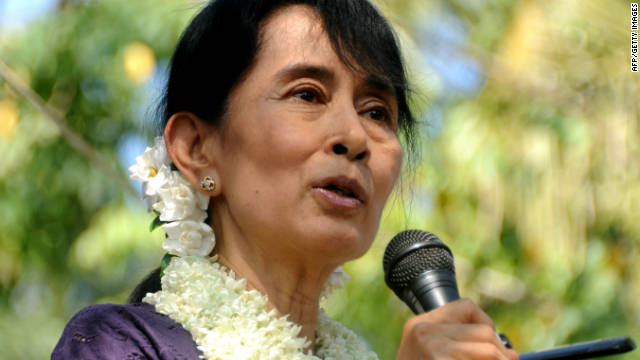
She is small but only in physical stature. Aung San Suu Kyi is the very embodiment of Myanmar's long struggle for democracy.

Aung San Suu Kyi has become the very embodiment of Myanmar's long struggle for democracy.


She is small but only in physical stature. Aung San Suu Kyi is the very embodiment of Myanmar's long struggle for democracy.
The 66-year-old human rights icon defied Myanmar's authoritarian military junta with her quiet demeanor and grace when she spent 15 of 21 years under house arrest for her unending opposition to authoritarian rule in Myanmar.
By the time she was freed in November 2010, she had become, perhaps, the world's most recognizable political prisoner. She was awarded the 1991 Nobel Peace Prize for her non-violent struggle for democracy and human rights.
Over the past year, Suu Kyi has met repeatedly with Myanmar's President Thein Sein and the country's minister for labor and for social welfare, relief and resettlement, Aung Kyi.
Now, she will participate in Myanmar's next elections, Nyan Win, the spokesman for her National League for Democracy, said Friday. Her National League for Democracy announced earlier Friday that it planned to re-register as a political party and participate in all future parliamentary elections.
During her captivity, she lived quietly by herself at her disintegrating Inya Lake villa in Yangon (the former capital, also known as Rangoon), accompanied solely by two maids.
She had little outside human contact except for visits from her doctor.
Sometimes, though, she was able to speak over the wall of her compound to her supporters, never once tiring of her crusade to break down the tyranny of dictatorship in her beloved homeland of Burma, the alternate name for Myanmar.
Known as the "lady" in Myanmar, Suu Kyi has been compared to former South African President Nelson Mandela, who spent a chunk of his life in jail for fighting apartheid.
In an interview with CNN several years ago, Suu Kyi, in fact, likened Myanmar's plight to South Africa's former brutal race-based system.
"It's a form of apartheid," she said. "In Africa, it was apartheid based on color. Here, it is apartheid based on ideas. It is as though those who want democracy are somehow of an alien inferior breed and this is not so."
The daughter of Gen. Aung San, a hero of Burmese independence, Suu Kyi spent much of her early life abroad, going to school in India and at Oxford University in England.
She never sought political office. Rather, leadership was bestowed upon her when she returned home in 1988 after her mother suffered a stroke.
During her visit, a student uprising erupted and spotlighted her as a symbol of freedom. When Suu Kyi's mother died the next year, Suu Kyi vowed that just as her parents had served the people of Burma, so, too, would she.
In her first public speech, she stood before a crowd of several hundred thousand people with her husband, Michael Aris, and her two sons and called for a democratic government.
"The present crisis is the concern of the entire nation," she said. "I could not, as my father's daughter, remain indifferent to all that was going on. This national crisis could, in fact, be called the second struggle for independence."
She won over the Burmese people. One of them was Nyo Ohn Myint, who participated in the 1988 protests as a college professor and now serves as one of the leaders in Suu Kyi's National League for Democracy.
"She is more than her father's daughter," he told CNN. "She has proven that she can bring together the Burmese people."
In 1989, the military regime threw her in jail. But even with Suu Kyi sitting behind bars, her party won the elections the following year by a landslide, gaining 82 percent of the seats in parliament.
The regime ignored the results of the vote and Senior Gen. Than Shwe continued to impose numerous terms of house arrest on her. Suu Kyi, meanwhile, became the recipient of several human rights prizes and was awarded the Nobel Peace Prize in 1991.
Over the years, Suu Kyi repeatedly challenged the junta and discouraged foreign investment in Myanmar. In one incident in 1998, soldiers prevented her from leaving Yangon. But Suu Kyi refused to turn back and was detained in her minivan for almost two weeks. The ordeal left her severely dehydrated, but was typical of her almost stubborn determination.
Myint described her as energetic but humble. And a good listener.
"That's a skill I barely see in other people," Myint said.
She has remained a devoted Buddhist who from the beginning admired the principles on non-violence and civil disobedience espoused by India's Mahatma Gandhi, Myint said.
Over the years, Suu Kyi has made clear her devotion to bringing democracy to Myanmar. She has spoken of her separation from her loved ones as the sacrifice she chose to make for the freedom of her country.
Her dying husband petitioned the Myanmar authorities to allow him to visit his wife. He had last seen her in 1995, but his request was rejected.
Instead, the junta encouraged Suu Kyi to join her family abroad. But she said she knew that if she left, she would never be allowed to return. Aris died of prostate cancer in March 1999.
Even before they were married, Suu Kyi had penned a letter to Aris professing her love of country.
"I only ask one thing," she wrote, "that should my people need me, you would help me to do my duty by them."
Myint recalled calling her to express his condolences after Aris died in 1999. Suu Kyi was calm on the phone for the four-minute conversation but Myint could tell her heart was breaking.
"Maybe we are good at politics," Suu Kyi told Myint. "But we are bad at family matters."
Suu Kyi tried to break the monotony of her life by playing her piano, another passion in her life, according to the independent Irrawaddy magazine.
But in time, the piano warped and Suu Kyi turned to painting to fill the void, the magazine reported. One day, maybe, people will see her canvases.
Suu Kyi has also asked her lawyers to bring her books in English and French.
Nobel Prize-winning economist Joseph Stiglitz had been allowed to present her with his book "Globalization and Its Discontent."
In 2007, people defiantly took to the streets to protest rising fuel costs. The demonstrations were seen as a direct challenge to the authority of the government.
The regime answered with a brutal crackdown. Suu Kyi's detention was extended again and again. She appeared gaunt -- and unhappy.
Even when Cyclone Nargis devastated Myanmar in May 2008, Suu Kyi was not allowed to leave her house, though trees were crashing down all around her.
The following year, Myanmar was again propelled into the headlines by a bizarre incident involving an American, John Yettaw, who improvised flippers to swim Inya Lake to Suu Kyi's compound. He said he had received a message from God to do so. Yettaw was arrested, and Suu Kyi was put on trial, charged with harboring Yettaw, and was punished with another 18 months of house arrest.
Some believe that Suu Kyi's stubborn defiance has become an obstacle to progress in Myanmar. But her followers remain ardent in their admiration. She has clung to her dream of democracy, peace and freedom for Myanmar's 50 million impoverished people, they say.
Those simple ideals have greatly complicated one woman's life.

By Moni Basu and Dan Rivers, CNN